Vidya – AI Study Platform
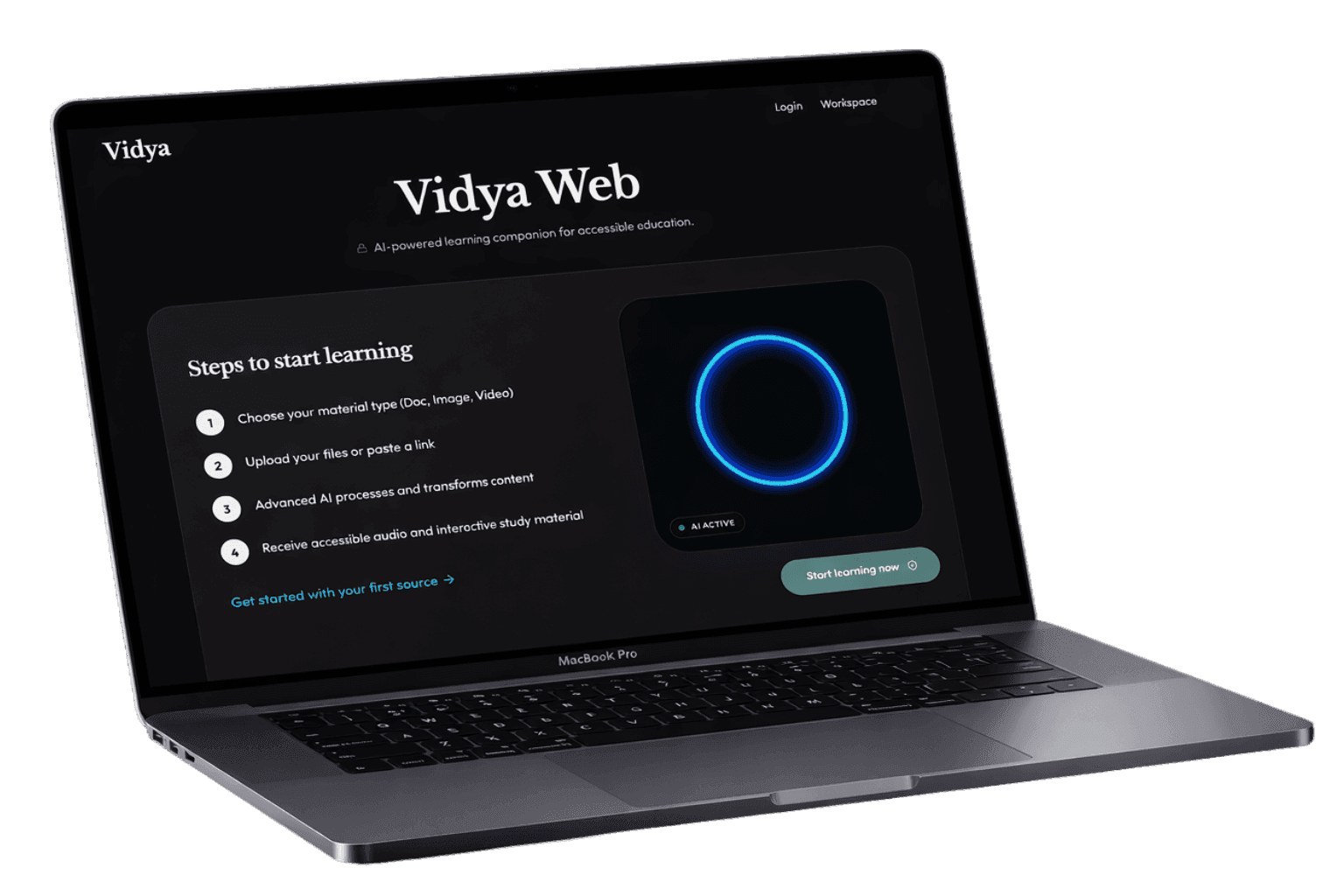
A cinematic, AA-compliant learning sanctuary—where 'inclusive education' isn't just a checklist, but a multimodal AI exp...
Why and How
I built this.
"I realized that the 'Big Gap' in education is the rigidity of the medium. Textbooks are often 'locked rooms' for students with disabilities."
"Collaborated with accessibility experts to map the 'Inclusive Learning Pathway,' auditing LMS platforms for AA compliance."
"We validated that students with disabilities spend up to 3x more time simply accessing content than learning it."
01Problem Identification
Traditional education has a gatekeeping problem. While most students can simply open a PDF or watch a YouTube lecture, over 10 million students with visual or hearing impairments, or learning disabilities like dyslexia, are met with an invisible wall.
Educational materials are fundamentally designed for the average learner, leaving students with disabilities to struggle with inaccessible layouts, complex jargon, and non-adaptive formats.
Existing 'accessibility tools' are often clunky and lack the premium aesthetic needed to make learning truly effortless.
02The Solution Hypothesis
Vidya acts as a universal translator for knowledge. It 'inhales' any medium—a complex PDF, a fast-paced video, or messy handwritten notes—and 'exhale' it in the specific format a student needs: be it audio, simplified text, or interactive quizzes.
03The "Oops" Moment
In the early pilot, I focused too much on making the AI 'smart' and not enough on making the UI 'simple.' The dashboard was overwhelmed by complex menus.
Testing with a screen-reader user revealed 'navigational noise.' I realized that true accessibility is minimalism.
I stripped the UI back to essentials, implementing the 'Single Action' rule where the primary learning node is always the main focus.
Inclusive Learning Pathway mapping
Multimodal Transformation Engine
Screen-reader optimized UI architecture
High-contrast 'Electric Pulse' visual theme
Real-time AI-driven pedagogical summaries
Modern Discovery.
Conducted an intensive discovery phase involving focus-group participants and competitive landscape audits to establish the project's foundation.
Strategic Breakthroughs.
Users feel overwhelmed by data complexity
Mobile-first interaction is non-negotiable
Speed-to-value determines long-term retention
Strategic Methodologies.
User Surveys
Hotjar Analysis
A/B Testing
Focus Groups
Multimodal Transformation Architecture.
Inclusive learning pathway with accessibility guards
Multimodal Source
PDF documents, audio, video & web text sources
Accessibility Adaptor
Decision: Checks font scale, contrast & screen reader rules
Gemini AI Transformer
Generates bite-sized summaries & adaptive quizzes
Inclusive Learning Hub
Accessible interactive study workspace
Multimodal Source
PDF documents, audio, video & web text sources
Accessibility Adaptor
Decision: Checks font scale, contrast & screen reader rules
Gemini AI Transformer
Generates bite-sized summaries & adaptive quizzes
Inclusive Learning Hub
Accessible interactive study workspace
"Vidya ingests complex educational media (PDFs, videos, handwritten notes) and filters them through AA/AAA accessibility rules. The system exhales content into Dyslexia-friendly typography, voice guidance, and bite-sized interactive quizzes."
Design
Process.
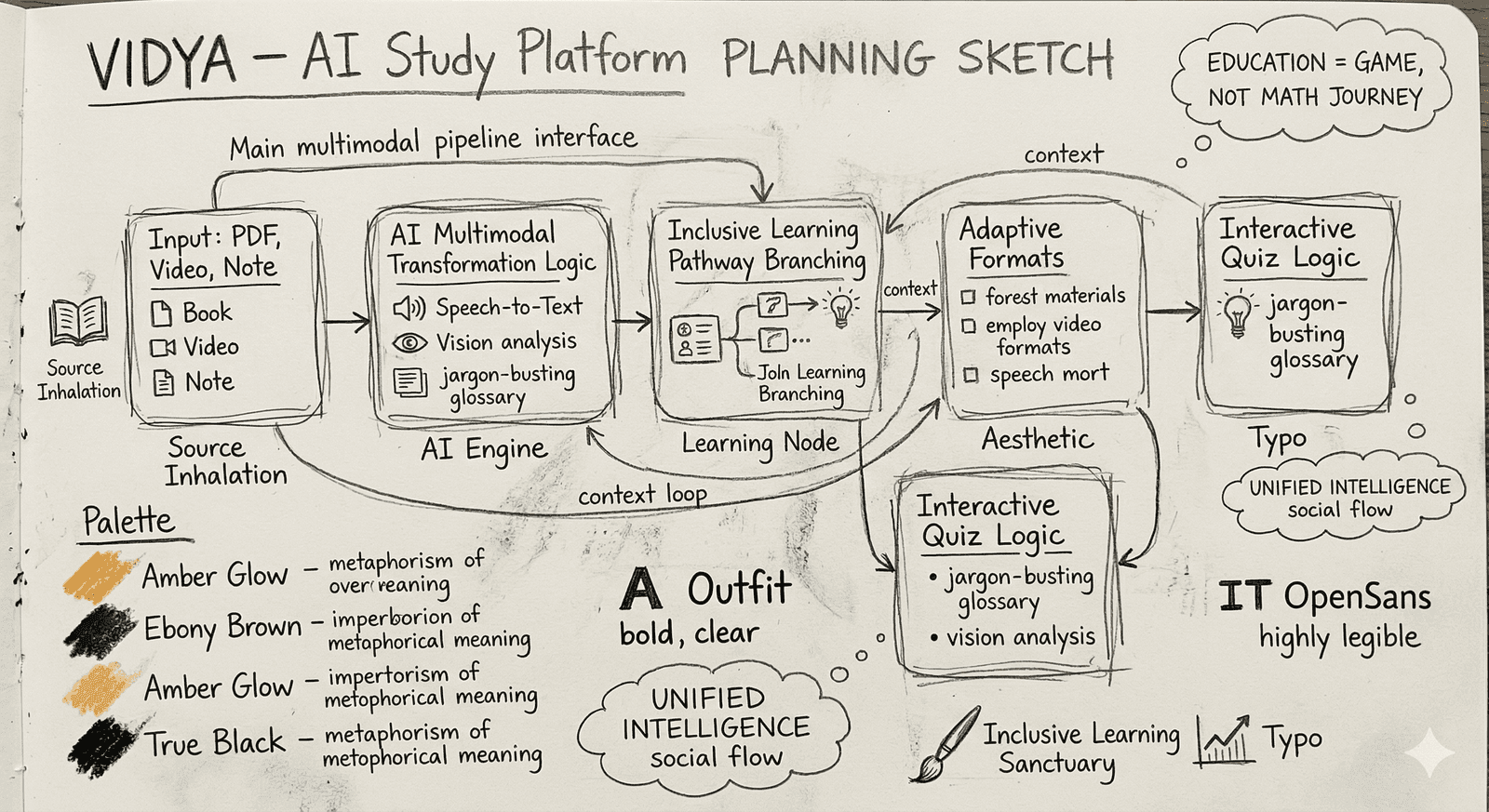
The core of Vidya is the Inclusive Learning Pathway. In my sketchbook, I mapped out the 'Multimodal Engine,' tracing how a source is processed into specific formats like Audio, Simplified Text, or Quizzes based on learned needs.
State 01
Inhale Phase: A PDF or YouTube Link is ingested by the Multimodal Engine.
State 02
Logic Branching: The AI determines the necessary transformation (Audio, Dyslexia-friendly text, or Summary).
State 03
Exhale Phase: The content is delivered as a screen-reader optimized summary or voice-guided interactive quiz.
State 04
Validation: Pedagogy is checked to ensure simplified content retains core academic meaning.
Color
Palette.
The design philosophy is 'Inclusive Clarity.' We balanced strict accessibility standards with a modern, high-end feel.
Electric AI Pulse (#0284C7) represents focus and multimodal energy, while Deep Obsidian (#0D1117) ensures AAA color contrast ratios alongside calming teal accents (#2DD4BF).
Typography choice: Outfit for premium headers and OpenSans for dyslexic-friendly body text readability.
Typography & Fonts
Outfit (Headers)
OpenSans (Body/Dyslexia-friendly)
Signature Atoms
Engineering
Excellence.
Built with Next.js for SSR and performance. The Multimodal AI Engine leverages the Gemini API for pedagogical summarization.
Integrated OpenAI Whisper for video transcription and OpenAI Vision for complex document analysis.
Developed a real-time engine that generates AI-driven quizzes based on transformed content to boost retention.
Frontend Layer
Built with Next.js & Tailwind for lightning-fast rendering and responsive boutiques.
Core Engine
Leverages PostgreSQL & AI SDKs to process complex user intents and data structures.
Measured Impact.
95% accuracy in pedagogical content simplification
Increased student engagement by 35% via interactive quizzes
Designed a pathway capable of serving 10M+ diverse learners