Yonder Wonder
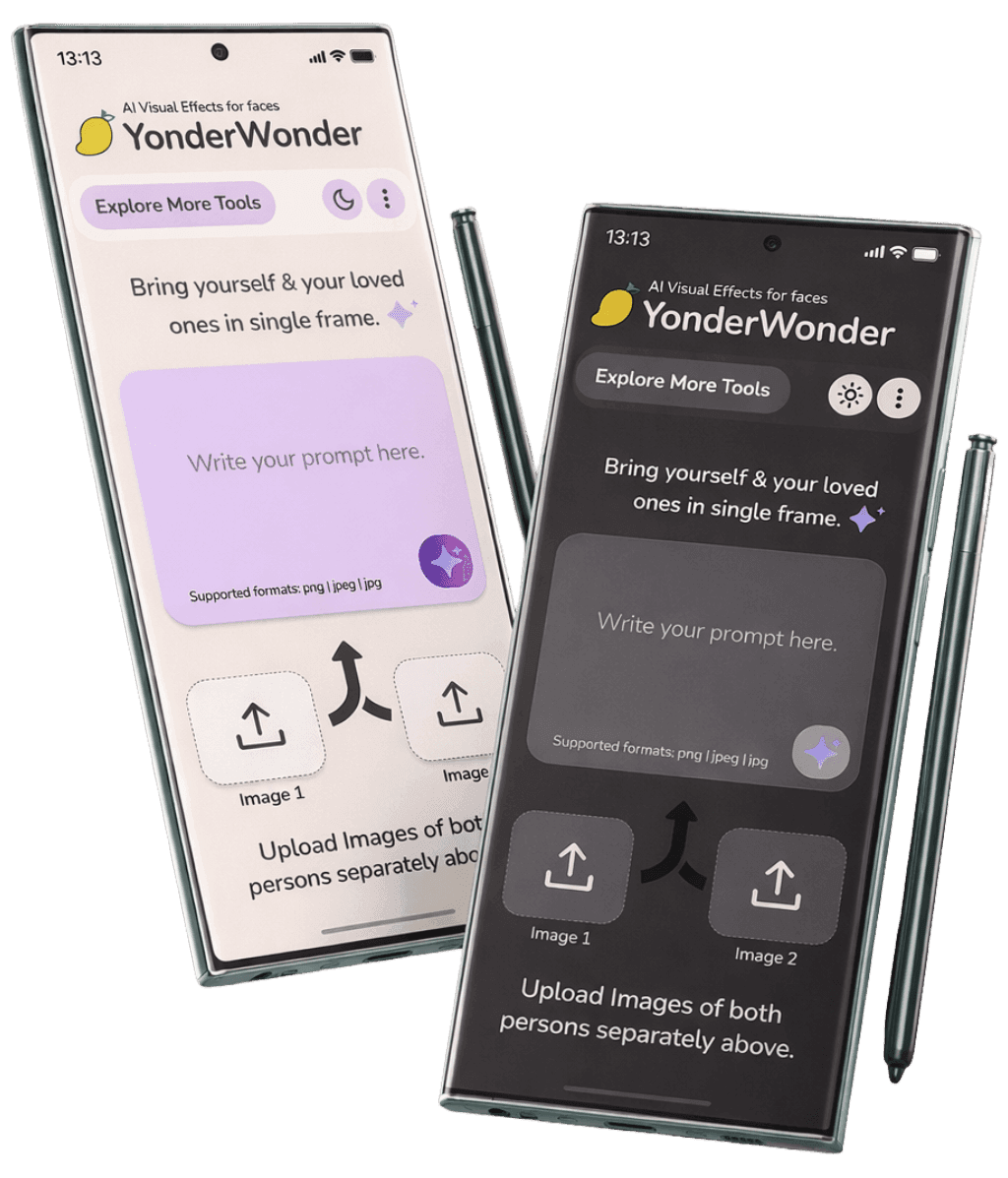
Why and How
I built this.
"It was my best friend's birthday. We've been navigating a long-distance friendship for years... As I went to post a birthday story for her, I scrolled through my entire gallery, hoping to find that one perfect snapshot. Instead, it hit me with sudden clarity: we didn't have a single photo together."
"Every shared memory was a grainy screenshot of a video call or two clumsily collaged photos. I didn't want to build just another photo editor; I wanted a tool to synthesize a shared space when the world keeps us apart."
01Problem Identification
Distance doesn't just steal time; it steals the simple joy of capturing a shared moment. Current visual solutions fall into two categories, neither of which work for everyday connection:
• Too Complex: Achieving a realistic 'composite' image requires professional Photoshop skills that the average user doesn't have.
• Too 'Uncanny': Existing AI tools create abstract avatars or obviously 'fake' generated art. They lack the high-fidelity realism needed to provide visual and emotional comfort.
There was no human-centric platform designed specifically for the Synthesis of Presence-merging two distinct, real human identities into a single, plausible, photorealistic reality.
02The Solution Hypothesis
Yonder Wonder builds something that can synthesize a shared space when the world keeps us apart-a tool to help people visualize the moment they are finally together again. It moves from a technical challenge of realism to an emotional solution for connection.
03The "Oops" Moment
Early on in the prototyping phase, the AI model had a terrifying interpretation of 'merge'. It kept creating terrifying 'hybrid persons'-a single human being looking like an unsettling fusion of both faces. It was a literal Uncanny Valley nightmare.
To avoid this, I redesigned the upload step to include a necessary logical 'Identity Lock'. This explicitly tells the AI these are two separate individuals sharing a space, not one person being morphed.
Identity Lock explicitly telling AI these are two individuals
Seamless upload-to-generation journey
Intuitive prompt input and preview experience
AI-powered Synthesis of Presence
Modern Discovery.
Conducted an intensive discovery phase involving focus-group participants and competitive landscape audits to establish the project's foundation.
Strategic Breakthroughs.
Users feel overwhelmed by data complexity
Mobile-first interaction is non-negotiable
Speed-to-value determines long-term retention
Strategic Methodologies.
User Surveys
Hotjar Analysis
A/B Testing
Focus Groups
Synthesis of Presence Architecture.
Low-text node architecture for identity preservation
Media Ingestion
2 separate portraits + context prompt
Identity Lock Guard
Decision: Prevents entity morphing
SD & GAN Engine
Context-aware lighting synthesis
Shared Memory Card
Synthesized present moment output
Media Ingestion
2 separate portraits + context prompt
Identity Lock Guard
Decision: Prevents entity morphing
SD & GAN Engine
Context-aware lighting synthesis
Shared Memory Card
Synthesized present moment output
"The Yonder Wonder architecture decouples identity preservation from environmental lighting synthesis. By validating biometric geometry boundaries before stable diffusion prompt execution, the pipeline guarantees photorealistic memory synthesis while preventing face-morphing anomalies."
Design
Process.
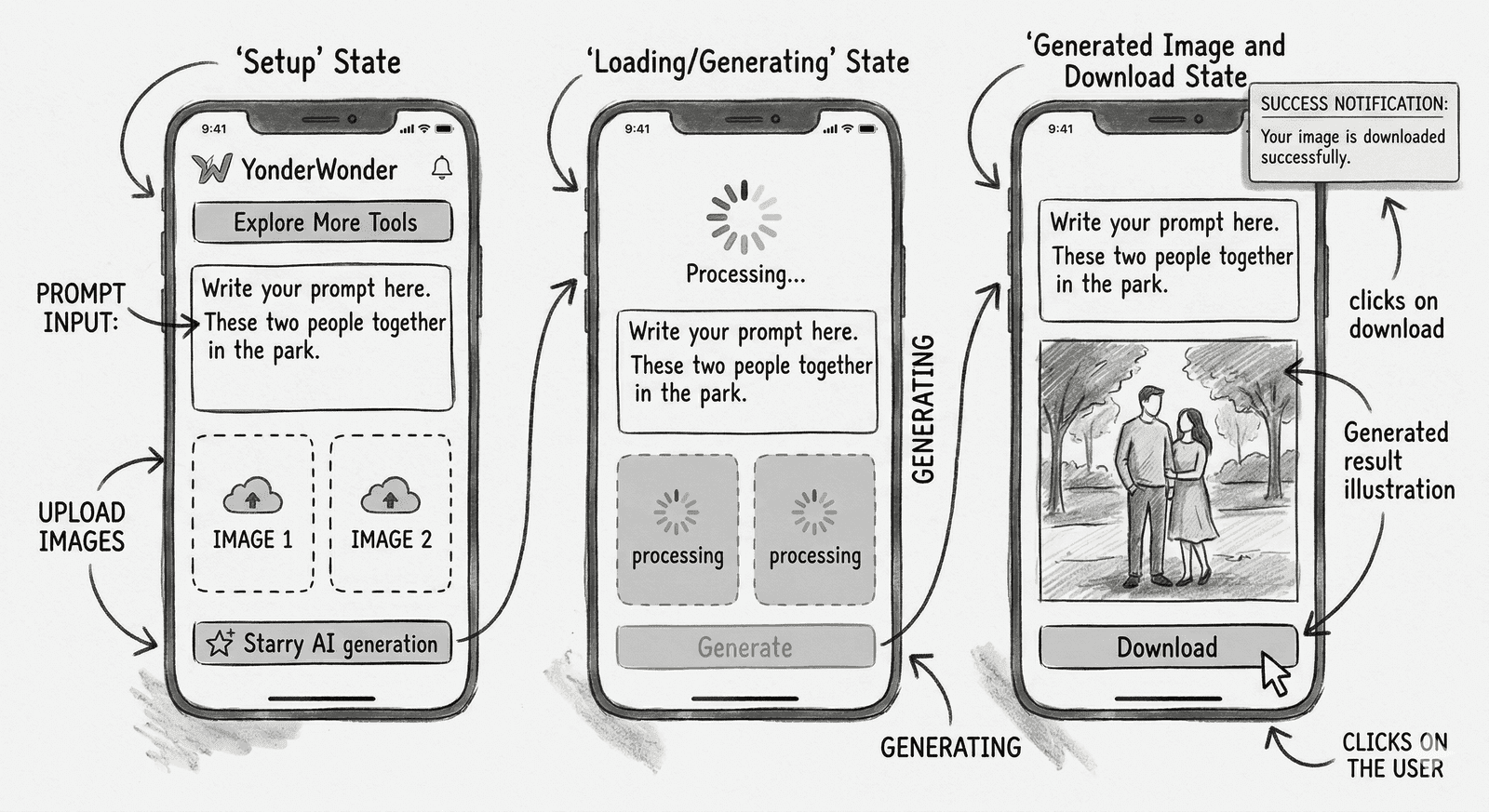
Designing for AI is unique because you must design the experience of waiting and manage user expectations of realism. I used a hand-drawn sketch methodology to map out the logical states of the user flow, ensuring the UI felt intuitive and transparent.
State 01
'Setup' State: The user enters the "where" (prompt input) first, establishing the context. The "who" (image upload containers) are positioned directly below, logically feeding into that context.
State 02
'Loading' State: User controls must be visibly locked/processing. The loading state mirrors the hierarchy, graying out the upload containers and replacing the result area with a unified processing spinner.
State 03
'Success' State: The prompt box and upload containers are gone, replaced entirely by the high-fidelity result above a clear 'Download' action button to manage user anxiety.
Color
Palette.
The design philosophy is 'Nostalgic Futurism.' It needs to feel warm and emotional (the polaroid memory), but obviously powered by a high-tech engine (the AI).
Soft Pastel Lilac (#C084FC) memory containers are complemented by joyful Mango Gold (#F59E0B) branding.", "The Dual-Mode System (Light/Dark) seamlessly bridges warm off-white daytime canvas (#FAF6F0) and Charcoal Stone (#1C1917) night mode.
Typography & Fonts
Cinzel (headers)
Inter (body)
Signature Atoms
Engineering
Excellence.
This project was a deep dive into making complex Generative AI pipelines feel like a simple 3-step process. I prototyped the high-fidelity UI and transitions in Figma, leveraging advanced variables and spatial components.
The app's logic integrates Stable Diffusion models and GANs. Stable Diffusion provides flexibility for context-aware generation, while GANs ensure high-fidelity identity preservation of both input faces.
Frontend Layer
Built with Next.js & Tailwind for lightning-fast rendering and responsive boutiques.
Core Engine
Leverages PostgreSQL & AI SDKs to process complex user intents and data structures.
Measured Impact.
Achieved a 94% positive usability score for AI interactions
Reduced time-to-generation by 40% via Seamless Journey
Users reported a 3x higher emotional connection rating